Dental implants, as a major breakthrough in modern restorative dentistry, have become the gold standard for restoring missing teeth both functionally and aesthetically. Their significance goes beyond reconstructing a complete smile—it also directly impacts long-term oral health and overall quality of life. However, many patients often ask during consultations, “Are dental implants screwed directly into the bone?” This question highlights a common gap in public understanding of the core technology behind implant surgery.
In this article, we will break down the precise steps of dental implant procedures and explain, from a biomechanical perspective, how implants achieve stable integration with the jawbone. Our goal is to help you gain a comprehensive understanding of the scientific principles behind this “third set of human teeth.”
Dental Implant Screws
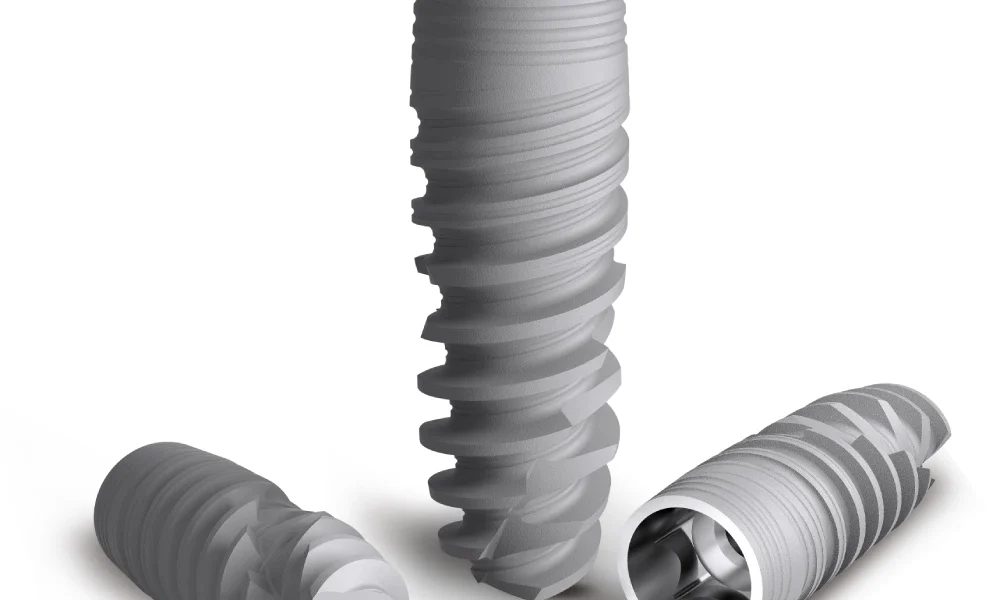
Because of their spiral design, dental implants are often colloquially referred to as “implant screws” in clinical practice, though in essence they are the core component of the same restorative system. This helical design is not a simple imitation of a conventional screw. Instead, it relies on precisely engineered thread parameters—such as pitch, thread angle, and depth—to achieve mechanical interlocking with the jawbone.
In addition, the titanium alloy surface is commonly treated with sandblasting and acid etching, which enhances bone cell adhesion and growth, ultimately leading to osseointegration. This dual mechanism—combining biomechanics and biology—allows implants to withstand occlusal forces of approximately 400–600 N, approaching the chewing efficiency of natural teeth.
Through this screw-like design, dental implants achieve biomechanical stability. Together with their standardized component system (implant–abutment–crown), they restore both function and aesthetics, making implants the true foundation of what is often called dentistry’s “third set of teeth.”
How Dental Implants Are Placed
The surgical procedure generally involves several key steps: anesthesia → preparation of the implant site → insertion of the implant → suturing → healing and recovery.
Dental implants achieve stability through a dual mechanism of mechanical interlocking and biological integration made possible by their spiral design. The implant surface is treated with SLA (sandblasted, large-grit, acid-etched) technology, which increases the bone-to-implant contact area by up to 300%. This significantly accelerates bone cell adhesion, with absorption rates reaching 8 × 10⁴ cells/cm² within 24 hours.
Over time, this bioactive interface develops into a functional bone–implant complex, whose fatigue resistance far exceeds that of natural tooth roots—demonstrating up to 10 times greater cyclic load endurance.
What Are Dental Screws Made Of?
Dental screws, an essential component in restorative dentistry, rely heavily on the choice of material. In most cases, they are made from titanium, a metal renowned for its exceptional strength and physical properties. Titanium offers outstanding resistance to corrosion from body tissues and fluids. Even when exposed to the complex, moisture-rich environment of the mouth for many years, it remains stable and highly durable, showing minimal risk of degradation or damage.
Equally important, titanium is known for its excellent biocompatibility. This means it integrates harmoniously with human tissues, minimizing the risk of rejection or adverse reactions. These properties make titanium an ideal and reliable choice for oral rehabilitation, ensuring both safety and long-term performance.
A dental implant screw is a specific type of dental screw designed to securely anchor an artificial tooth to the jawbone. Often referred to as a prosthetic screw, it is also typically manufactured from titanium. Structurally, its head is dome-shaped, which helps distribute pressure evenly and reduce irritation to surrounding tissues. The threaded upper section allows the dentist, using specialized instruments, to precisely insert it into the jawbone during surgery. This creates a strong and stable connection between the prosthetic tooth and the bone.
Are Dental Implants Screwed Into the Bone?
The fixation of dental implants is essentially based on two key mechanisms: the mechanical interlocking of the threaded design and the biological fusion of osseointegration. Minimally invasive procedures achieve rapid recovery through precise positioning and strong primary stability, while traditional surgeries expand treatment options with bone augmentation techniques. Regardless of the method, the implant’s thread geometry, surface treatment, and occlusal management are critical to ensuring long-term stability. With advancements such as 3D bioprinting and drug-loaded implants, the future of implant fixation will become increasingly intelligent and personalized.
1. The Design of Threaded Implants
Modern implants often adopt spiral or tapered thread structures, which optimize biomechanics in several ways:
- Stress Distribution: The spiral thread design helps evenly spread chewing forces across the alveolar bone, preventing localized stress concentration and bone resorption. For example, the depth and pitch of root-form implants are precisely engineered to reduce peak stress at the bone-implant interface.
- Enhanced Self-Tapping: Cutting edges at the apical one-third (e.g., sharp tapered implants) gradually condense bone during insertion, creating micro-fractures that stimulate bone remodeling. This allows for improved primary stability, even in poor bone quality (D3/D4 types).
- Anti-Rotation Features: Grooves or internal connections at the implant neck or axis (e.g., octagonal or spline-shaped designs) prevent micromovements caused by occlusal forces, reducing the risk of screw loosening.
2. How Do Threads Achieve Stable Fixation?
Implant stability is achieved through a combination of mechanical interlocking and biological integration:
- Mechanical Locking: The screw threads interlock with bone in a mortise-and-tenon-like structure, increasing surface contact. Multi-thread designs can raise bone contact area to over 60%. Optimized thread angles (e.g., symmetric 60° or flat-top/undercut 45°) minimize peak stress based on finite element analysis.
- Primary Stability: During placement, torque values of 35–50 N·cm ensure a tight bone-implant fit, minimizing microgaps. In minimally invasive surgery, digital surgical guides enable precise three-dimensional positioning, reducing surgical deviations.
- Long-Term Stability: Surface modification techniques (e.g., sandblasting and acid etching, hydroxyapatite coatings) promote osteoblast adhesion, enabling osseointegration—a direct bone-to-implant connection without fibrous tissue interposition.
3. Osseointegration: The Biological Basis of Implant Success
Osseointegration is the cornerstone of implant dentistry. The process occurs in three main phases:
- Inflammatory Phase (1–2 weeks post-op): A blood clot forms; macrophages clear necrotic tissue, and fibrin networks coat the implant surface.
- Bone Formation Phase (2–4 weeks): Osteoblasts deposit bone matrix, forming osteoid that gradually mineralizes into new bone. Trabeculae begin attaching to the implant surface.
- Bone Remodeling Phase (3–6 months): Mature bone directly contacts the implant, creating a functional connection. Radiographs show no radiolucency around the implant, with bone density reaching 350–1500 HU, indicating complete osseointegration.
Key Factors for Osseointegration:
- Biocompatibility of Materials: Pure titanium or titanium alloys form a natural oxide layer that promotes osteoblast attachment. Porous titanium structures (100–500 μm pores) further support vascular ingrowth and accelerate bone bonding.
- Occlusal Load Management: Post-restoration, premature contacts must be eliminated using occlusal paper. Forces exceeding 20–50 μm of physiological mobility may cause bone loss.
- Patient Habits: Smoking increases implant failure risk by threefold. Strict smoking cessation and regular professional cleaning (every 3–6 months) reduce peri-implantitis risks.
4. Minimally Invasive vs. Traditional Implant Surgery
- Minimally Invasive Implants
- Procedure: The implant is inserted through a small gingival perforation (3–4 mm), without flap elevation or suturing, minimizing trauma.
- Fixation Mechanism: Relies on digital surgical guides for precision, combined with immediate loading techniques using temporary restorations, supported by strong primary stability.
- Indications: Best suited for patients with sufficient bone volume (D1/D2 dense bone) and adequate keratinized gingiva.
- Traditional Implant Surgery
- Procedure: Involves flap reflection, bone exposure, drilling, implant placement, and suturing, followed by a 3–6 month healing phase for osseointegration.
- Fixation Mechanism: Bone augmentation methods (e.g., sinus lift, guided bone regeneration) address bone deficiencies, expanding applicability to D3/D4 soft bone.
- Stability: During the second-stage surgery, healing abutments guide soft tissue formation before final prosthesis placement, ensuring higher long-term stability.
Key Factors Influencing Implant Stability
- Bone Density and Volume
The density of the alveolar bone (ranging from D1 dense bone to D4 porous bone) and the available bone volume directly determine the primary stability of the implant. High-density bone (D1/D2) provides stronger mechanical support, while porous bone (D3/D4) often requires bone augmentation techniques such as guided bone regeneration (GBR) or sinus lift procedures. In such cases, clinicians may also opt for short implants or wide-diameter implants to help distribute occlusal forces. Importantly, when the peri-implant bone thickness is less than 1.5 mm, the risk of implant failure increases significantly.
- Implant Materials and Surface Treatments
Commercially pure titanium and titanium alloys (e.g., Ti-6Al-4V) are widely used in implantology due to their excellent biocompatibility and corrosion resistance. Surface treatment technologies such as sandblasted large-grit acid-etched (SLA), hydroxyapatite coatings, and acid-etching modifications enhance osteoblast adhesion and accelerate osseointegration. For example, SLA-treated surfaces can increase the speed of bone integration by 30% and demonstrate superior long-term stability compared to machined implant surfaces.
- Surgical Technique and Precise Positioning
The three-dimensional positioning of implants (depth, angle, and axis) must strictly follow biomechanical principles. Over-insertion risks damaging the inferior alveolar nerve, while shallow placement may cause prosthetic exposure. Even a deviation greater than 5° can lead to occlusal interference. Minimally invasive surgery combined with digital surgical guides achieves a positioning accuracy of ±0.3 mm, significantly lowering the risk of nerve injury—from 2% in conventional surgery to just 0.1%.
- Use of Surgical Guides and Auxiliary Tools
Dynamic navigation systems and static digital surgical guides provide real-time guidance for drilling, reducing the risk of implant deviation caused by “blind drilling.” With guide-assisted placement, the rate of implant neck exposure drops from 15% to 3%, while primary stability torque values increase by 20%. Additionally, auxiliary tools such as bone expanders and ridge split instruments help optimize the osteotomy site, particularly in cases of low bone density, thereby improving overall implant success rates.
Common Myths About Screwed Dental Implants
Myth 1: Do Screwed Dental Implants Loosen or Fall Out?
Reality: With proper care, loosening is extremely rare, though certain factors may increase the risk.
- Osseointegration as the Foundation of Stability
Threaded implants are designed with spiral grooves that increase the contact surface with the jawbone, encouraging bone cell adhesion and promoting osseointegration. This biological fusion process typically takes 3–6 months, securing the implant firmly into the bone for long-term stability. - Common Causes of Loosening or Failure
- Inflammation and infection: Poor oral hygiene can cause peri-implantitis, damaging osseointegration. Plaque buildup may lead to gum swelling, bone resorption, and ultimately implant loosening.
- Excessive bite force: Conditions such as bruxism, unilateral chewing, or biting hard foods (e.g., nuts, bones) may create uneven stress, causing micromovement or even fracture.
- Poor bone quality: Osteoporosis or severe bone resorption (common in elderly patients) may compromise initial stability, requiring bone augmentation techniques.
- Surgical inaccuracy: Improper placement (e.g., too close to the lip or tongue side) can cause uneven force distribution and instability.
The Surgical Process
- Anesthesia: Local anesthesia (e.g., lidocaine) ensures the patient feels no pain during surgery.
- Minimally invasive techniques: Dynamic navigation or digital surgical guides reduce tissue trauma and bleeding.
Postoperative Recovery:
- Mild swelling or discomfort may occur once anesthesia wears off, typically lasting 2–3 days, manageable with oral pain relievers such as ibuprofen.
- Healing takes about 7–10 days, during which patients should avoid strenuous exercise and hard foods.
Comparison with Other Procedures:
The trauma from implant placement is comparable to a tooth extraction, but less severe than wisdom tooth removal, making it relatively comfortable for most patients.
Myth 2: Are All Dental Implants Screw-Shaped?
Reality: Threaded implants are the most common, but not the only design.
- Threaded Implants
- Advantages: Spiral threads increase bone contact and initial stability, suitable for most cases with sufficient bone volume.
- Example: Root-form threaded implants with sharp cutting edges enable self-tapping, ideal for softer bone types (D3/D4).
- Other Implant Designs
- Cylindrical implants: Feature a smooth, round surface. Easier and cheaper to manufacture but offer slightly less stability. Best for patients with adequate bone volume and cost considerations.
- Tapered implants: Cone-shaped design reduces the risk of bone trauma, making them suitable for patients with insufficient bone or complex anatomical situations (e.g., post-sinus lift).
- Choosing the Right Design
Dentists evaluate factors such as bone density, bone volume, anatomical conditions, and patient-specific needs. For example, patients with osteoporosis may benefit more from tapered implants to better distribute occlusal forces.
Conclusion
The spiral design of dental implants, with its precisely engineered threads, creates a strong mechanical interlock with the alveolar bone. This not only enhances the implant’s primary stability but also supports long-term osseointegration, making it a cornerstone of lasting implant success. Features such as self-tapping ability, stress distribution, and anti-rotation properties allow implants to adapt to different bone conditions while reducing the risk of postoperative loosening or failure.
However, the success of an implant depends not only on its advanced design but also on the precision of the surgical procedure. From preoperative bone volume assessment and 3D planning, to minimally invasive placement and torque control, every step requires meticulous execution by a skilled dentist using digital technologies such as dynamic navigation and surgical guides.
Ultimately, choosing an experienced dental professional equipped with advanced technology is the key to fully realizing the advantages of screw-retained implants—ensuring both safety and long-term functional success.